If you are looking for mixed-use development opportunities tied to transit, Long Island deserves a close look right now. Station areas across Nassau County and western Suffolk County are shifting from commuter parking zones into walkable, mixed-use districts, and that change is creating real openings for investors, developers, and property owners. In this guide, you will see why demand is holding up, what local planning is encouraging, and which site features matter most before you move forward. Let’s dive in.
Why Long Island station areas stand out
Long Island’s station-area story is backed by both population scale and housing economics. Nassau and Suffolk counties together had about 2.92 million residents in the 2020 Census, with median household incomes of $146,202 in Nassau and $130,686 in Suffolk during the 2020 to 2024 ACS period. Housing costs also remain high, with median gross rents around $2,252 in Nassau and $2,255 in Suffolk, while median owner-occupied home values were $684,700 and $578,400 respectively.
That matters because transit-oriented mixed-use projects tend to work best where there is both density and spending power. In these counties, the combination of strong household income, elevated housing costs, and established downtowns supports demand for housing near stations and for convenience-based retail and service uses at street level. For investors and developers, that creates a stronger base for long-term mixed-use positioning.
Transit demand supports all-day use
A key reason these opportunities are gaining traction is that Long Island Rail Road demand is not just about the morning commute anymore. In 2024, the LIRR carried 75.5 million customers, which was up from 2023 and equal to 82.9% of 2019 ridership. Even more important, non-commutation ridership exceeded 2019 levels by 16.7%.
That shift changes how you should think about underwriting. Retail, food service, medical uses, and rental housing near stations can benefit from daytime, evening, and weekend traffic rather than depending only on office commuters. When ridership becomes more balanced throughout the week, mixed-use projects gain a more durable demand profile.
Service improvements also matter. The 2024 report notes that Ronkonkoma and Huntington service increased from hourly to half-hourly, which was associated with ridership gains of 33% and 12%, respectively. Better frequency can make nearby development more attractive because it improves convenience for residents, workers, and visitors.
Public planning is pushing mixed use
Local governments across Long Island are increasingly treating train stations as development anchors. Nassau County has said transit-served downtowns are part of the county’s economic backbone and is studying transit-oriented development around up to three LIRR stations in the Nassau Hub area. Suffolk County’s Transit-Oriented and Downtown Development division also highlights diversified housing choices, pedestrian and bicyclist infrastructure, public input, and downtown revitalization.
There is also scale behind the planning effort. Nassau County cites estimates of roughly 8,300 acres of surface parking, vacant land, and open space for redevelopment across more than 150 downtown and station areas. That does not mean every parcel is ready today, but it does show how large the opportunity set may be over time.
What Long Island TOD usually looks like
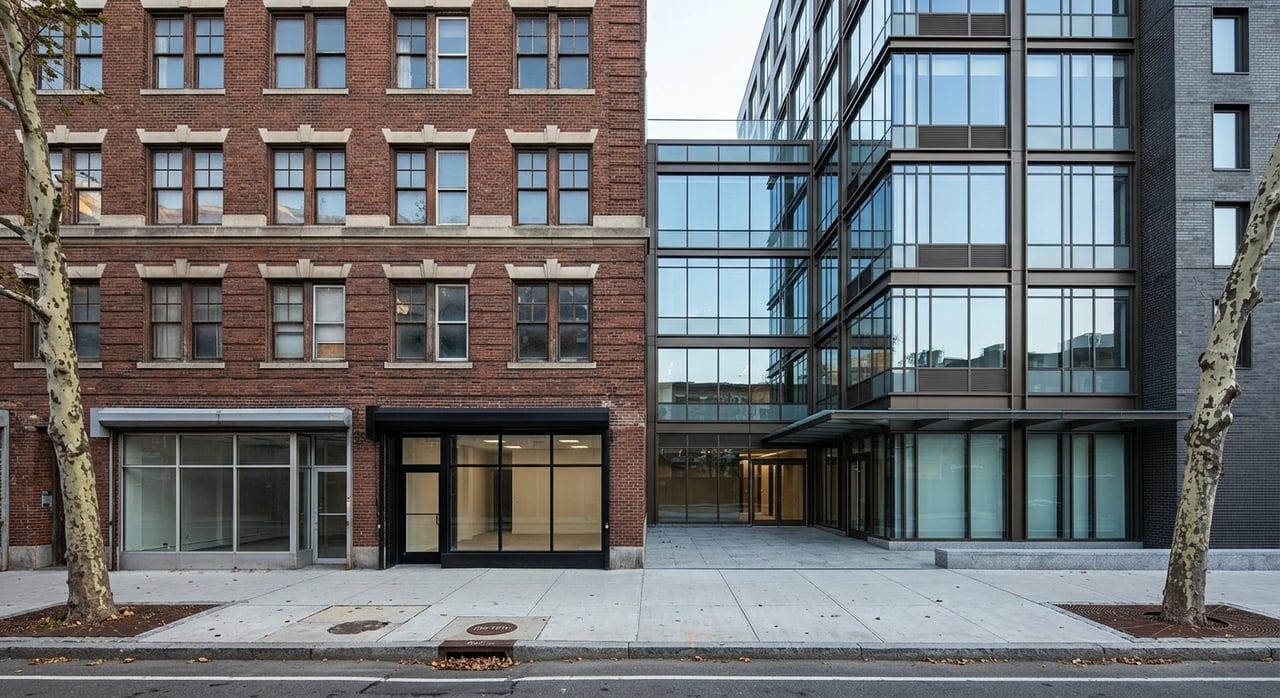
On Long Island, the typical station-area redevelopment pattern is not ultra-high-rise construction. It is usually walkable, station-adjacent, mid-rise mixed use shaped by rezoning, form-based codes, design standards, and public-realm improvements. In practice, that often means housing over retail, office or medical space, adaptive reuse, and parking designed to be less visually dominant.
Many local plans start with underused industrial land, older retail or office strips, or large parking fields. From there, municipalities often update zoning, revise parking approaches, and improve pedestrian connections. That combination can turn low-intensity land near stations into more active, mixed-use projects.
Local examples worth watching
Ronkonkoma
Brookhaven adopted a transit-oriented development district and a form-based implementation plan for about 53.73 acres around the station. The plan calls for pedestrian-friendly development with higher densities and a mix of housing, retail, office, and other uses. The broader project description includes 1,450 residential units, 360,000 square feet of office and medical space, 195,000 square feet of retail, and 60,000 square feet of hospitality and community space.
Westbury
The Village of Westbury identified the Maple and Union area, a 25-acre district next to the LIRR station, as a target for mixed-use transit-oriented redevelopment. The area had been zoned for industrial uses before the shift toward mixed use. Local planning also links rezoning with a new parking structure and residential development around that garage, showing how parking and housing can be planned together.
Hicksville
Hicksville’s planning materials focus on rebuilding a more walkable downtown and encouraging people to treat the area as a destination, not just a transit stop. Eligible private projects can include new residential and mixed-use buildings, hotel uses, adaptive reuse, façade work, and ground-floor retail, office, or coworking improvements. For developers, that points to a flexible but design-sensitive framework.
Mineola
Mineola has pursued a long-term transit-oriented strategy centered on smart growth, density bonuses, and mixed-use development. Planning documents call for station plazas, an intermodal transportation center, and contextual downtown zoning. They also emphasize practical limits such as water, sewer, and road capacity, which is an important reminder that infrastructure can shape what is realistic on any site.
Wyandanch
Wyandanch Rising shows a broader redevelopment model that combines infrastructure and vertical development. The plan includes sewers, a new train station, station plaza open space, 240 units of affordable and workforce housing, 50,000 square feet of retail, streetscape improvements, and wider downtown rebuilding. It is a strong example of how station-area redevelopment often depends on sequencing public improvements before private construction scales up.
What sites tend to work best
Not every parcel near a train line is a real transit-oriented opportunity. Across Long Island’s active examples, the strongest sites usually share a few practical traits.
Direct station access
Sites with immediate station access or a clear pedestrian route tend to stand out. Station plazas, safer crossings, upgraded sidewalks, and wayfinding appear repeatedly in plans for Mineola, Hicksville, Westbury, Ronkonkoma, and Wyandanch. If people cannot move easily between the station and the project, the transit premium gets weaker.
Existing all-day activity
Projects perform better when they sit near established downtown uses that already create movement throughout the day. Existing retail, civic uses, medical offices, and surrounding housing can support mixed-use economics better than isolated parcels. That is especially important for ground-floor space that depends on regular foot traffic.
Infrastructure capacity
Infrastructure is not a small checklist item. Mineola’s plan points to water, sewer, and roadway limits, while Wyandanch’s planning materials show sewer installation as a prerequisite to larger vertical development. Before you spend too much time on concept design, utility and roadway capacity should be part of your first-pass review.
Realistic density
The most workable Long Island station-area projects are usually mid-rise and incremental. Ronkonkoma, Hicksville, and Westbury suggest that the local market and code often support mixed-use density, but not extreme height. A realistic density plan is often more valuable than an aggressive concept that struggles in approvals.
Integrated parking
Parking still matters, but the strongest plans reduce its visual impact. Rear parking, wrapped garages, and integrated commuter parking are recurring strategies in local planning documents. If parking dominates the site plan, it can weaken walkability and reduce the quality of the street frontage.
What this means for underwriting
For investors and developers, Long Island transit-oriented mixed use is often a land-use conversion play. Underused industrial parcels, older commercial properties, and large parking fields near stations may offer the clearest path to repositioning, but only when zoning, access, infrastructure, and public support align. That means the best opportunity is rarely about location alone.
Approval risk is also part of the equation. Local programs such as Hicksville’s Downtown Revitalization Initiative materials emphasize site control, feasibility, public support, community benefit, and catalytic impact. In other words, a strong deal often needs both a sound financial story and a project concept that fits the local planning vision.
This is one reason station-area opportunities can reward a disciplined local approach. If you are evaluating a site, you need to understand not just price per square foot, but also the zoning path, likely timeline, parking treatment, and whether the parcel fits the municipality’s broader goals for downtown growth.
How to evaluate an opportunity faster
If you want a practical screen before going deeper, focus on these questions first:
- Is the property within a comfortable walk of the station?
- Is it in or next to an established downtown area?
- Does local planning already support mixed-use or transit-oriented redevelopment?
- Are water, sewer, and road capacity likely to support the concept?
- Can parking be handled without overpowering the site?
- Is there a realistic path to community and municipal support?
A site that checks most of those boxes may be worth a full review. A site that misses several of them may still have upside, but it will likely require more time, more capital, and a more patient strategy.
Why local market execution matters
Transit-oriented mixed-use opportunities on Long Island are highly local. Two sites near different stations can look similar on a map and perform very differently once you account for zoning, public process, infrastructure, and surrounding uses. That is why market depth, valuation discipline, and direct deal execution matter so much in this segment.
If you are exploring a sale, acquisition, assemblage, or repositioning strategy tied to station-area growth, a senior-led advisory approach can help you move faster on the right opportunities and avoid wasting time on the wrong ones. For tailored guidance on mixed-use sites, valuation, and off-market opportunities across Queens and nearby Long Island, connect with Asset CRG Advisors LLC.
FAQs
What are transit-oriented mixed-use opportunities on Long Island?
- They are development or repositioning opportunities near LIRR stations, often involving housing, retail, office, medical, hospitality, or community uses in walkable, mixed-use settings.
Why are Long Island station areas attracting more investor attention?
- Strong incomes, high housing costs, active public planning, and 2024 LIRR ridership of 75.5 million customers all support continued interest in station-area projects.
Which Long Island locations show active mixed-use planning near stations?
- Examples in the research include Ronkonkoma, Westbury, Hicksville, Mineola, and Wyandanch, each with local planning efforts tied to transit-oriented redevelopment.
What property types fit Long Island transit-oriented development best?
- Common formats include apartments over retail, office or medical space, adaptive reuse projects, hospitality or community uses, and projects with structured or integrated parking.
What should you review before buying a station-area development site on Long Island?
- You should review station access, surrounding uses, zoning path, infrastructure capacity, parking strategy, and the likelihood of public and municipal support before moving ahead.